
Vision
What if the place you live
felt a little more like family?
This page is about the deeper hope behind FIMBY, the kind of neighbourhood life it’s reaching for.
What we mean by family
Not family in the sentimental sense.
Not family as in everything is easy.
Family as in people know your name.
They notice when you are carrying too much.
They celebrate when something good happens.
They grieve when something precious is lost.
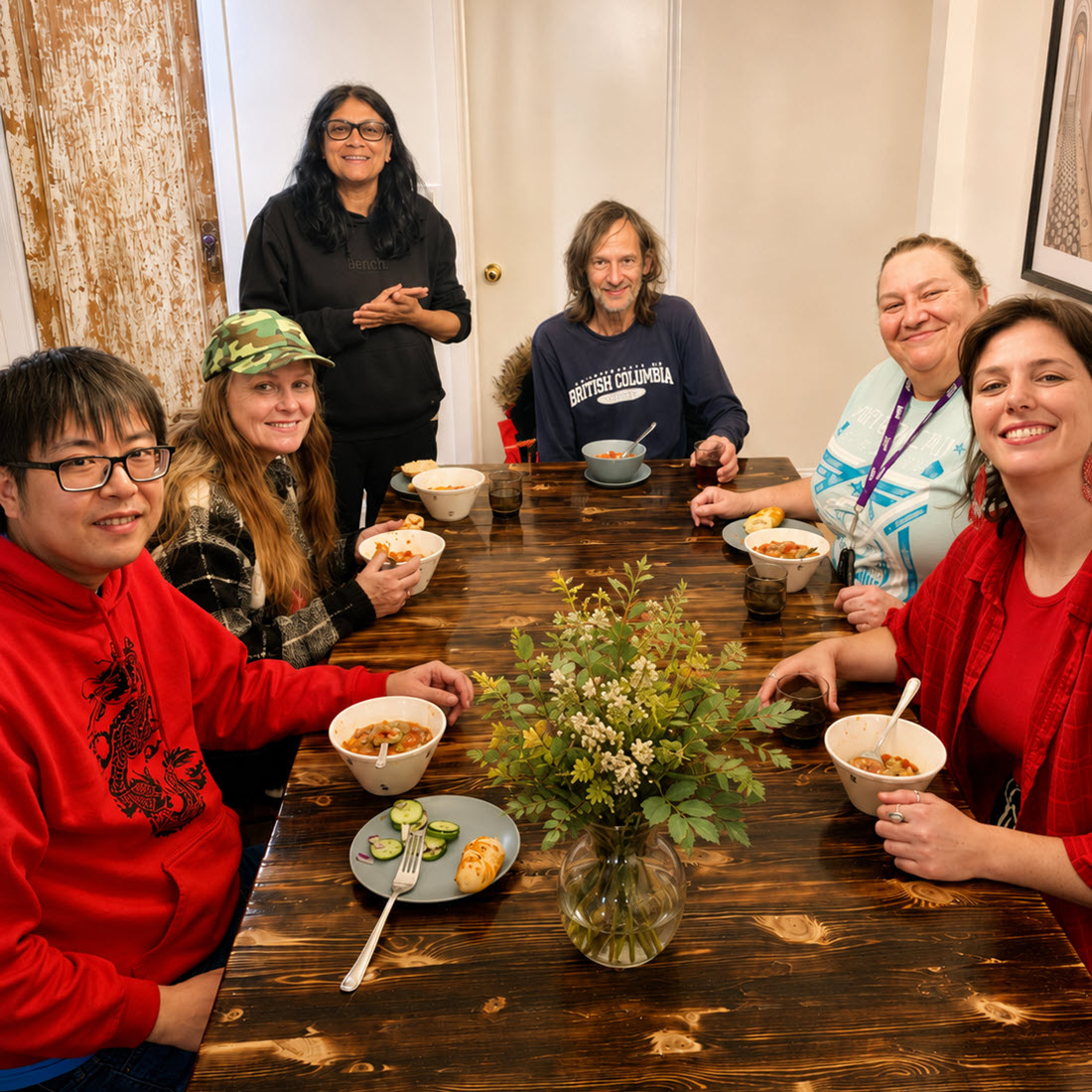
They make room at the table and pass the potatoes.
FIMBY is here to help grow.
It starts small.
- Learn a name.
- Share a loaf.
- Offer a ride.
- Ask for prayer.
- Lend the drill.
- Welcome the new person.
- Visit the elder.
- Receive help when you need it.

Not the fruit.
Just the trellis.
FIMBY is not the point. It is a trellis. A trellis does not create life, but it gives living things somewhere to climb.
trust one another, and show up for one another in ordinary ways over time.
What neighbourhood life
can feel like
A neighbourhood can be more than a collection of addresses.
It can become a place where people are a little less anonymous and a little more known. A place where a new neighbour is welcomed before a year goes by. A place where someone posts that they made too much soup, someone else needs a ride to an appointment, and someone nearby has a spare hour and a willing heart.
It can be a place where practical care and friendship are not separate things. A jump-started car becomes a standing friendship. A prayer request opens the door to deeper trust. A shared meal turns strangers into familiar faces. Small acts stop feeling small because they become part of the fabric of everyday life.
and no one has to pretend they have it all together.
It can also be a place that knows how to hold sorrow. Where the warmth and wisdom of an elderly neighbour are not quietly lost, but remembered together. Where grief is not outsourced. Where celebration and mourning both have witnesses.
This is the kind of ordinary FIMBY is reaching for. Not constant activity. Not forced closeness. Just a different sort of daily life. One where care is close enough to walk over.

Everyone has a part to play
In a healthy extended family, not everyone plays the same role.
Some people notice needs quickly. Some host. Some cook. Some fix things. Some lend tools. Some pray. Some make introductions. Some remember birthdays. Some organize. Some ask good questions. Some simply show up consistently and make a place feel steady.
FIMBY is built around the belief that neighbourhood life grows stronger not only when people give, but when people are allowed to need one another. Dependence is not failure. Often it is where trust begins. It takes humility to ask for help. It takes grace to receive it well. Both matter.
A healthy neighbourhood is not made up only of helpers. It is made up of people who learn, over time, how to give and receive with dignity.
Why neighbours?
No one can love the whole world. It is too big, and a single life is too short.
But each of us already has a few people nearby. Love was always meant to begin there, then widen.
Rooted, not scattered
FIMBY is shaped by a simple idea: local life matters.
Not because every meaningful relationship must stay small, but because a neighbourhood is one of the few places where life can actually be shared in practical ways. Care can move naturally when people live close enough to matter to one another in real time.
This is why FIMBY stays close to home. It is not meant to be a city-wide feed or a digital stage. It is meant to help neighbours recognize one another, help one another, and slowly build trust over time.
In knowing who lives nearby. In caring about the same streets. In sharing meals, rides, tools, stories, prayer, grief, and celebration with people you may see again tomorrow. In not always needing to drive across town to find the music, teaching, or culture that suits you best, because you are also learning how to love the people right where you are.

What happens to our divisions
when we share life?
It is easy to stay tribal when people remain abstract.
It is easy to sort ourselves by taste, denomination, politics, class, education, culture, age, or comfort. It is easy to imagine ourselves as generous people while keeping real neighbours at a safe distance. It is easy to love the idea of community and quietly avoid the people right in front of us.
Real relationship has a way of disturbing that.
When someone you would normally pass by becomes the person who checks in on you after surgery, your categories start to wobble. When the neighbour you once kept at arm’s length becomes a real face with a real story and a real need, the ground shifts.
When you help Vern get to Catholic Mass and suddenly discover a world of beauty and awe you never expected, preference loosens its grip a little.
They might make it harder to keep one another at a distance.
We may find ourselves caring for the very people we once kept at a distance. We may discover that some of the neighbours we had quietly sorted past are exactly the ones we were meant to know.
The part that’s still ours
Technology can help people coordinate. It can make needs visible. It can make offers easier to share. It can open a door.
But it cannot make us generous.
It cannot make us brave.
It cannot make us hospitable.
It cannot make us love our neighbour.
FIMBY is not a replacement for community, and it is not a substitute for essential services. It is one small way of helping neighbours and local groups stay more connected.
That is often how a neighbourhood changes. Not all at once. Just one small act of love at a time.
Practical questions next.
Browse the FAQ.
Pull up a chair?
If this neighbourhood is part of your real life, you’re welcome here.
Check your neighbourhood
with your postal code
activates your account
happening nearby
FIMBY not in your neighbourhood yet? Sign up anyway. We’ll add you to the waitlist and let you know when FIMBY launches near you.
Part of a community group or organization? You can join too. Just tick the box when you sign up.
For adults 19+. Families welcome: parents add a family profile from their own login. More in the FAQ.
Bring FIMBY here
FIMBY grows one neighbourhood at a time. If you’re a neighbour, organizer, church, or community group who’d help launch a hub, we’d love to hear from you.
- Gather 10–20 neighbours you can actually recognize
- Host a low-key intro: coffee, porch, or community room
- Optional moderator role with support from the FIMBY team
Still have questions?
You’ll find reassurance in our FAQ.