You can put it down
The places we went to feel close to people started asking us to perform, to optimize, to keep scrolling, and quietly sold what they learned about us along the way.
FIMBY is built backwards from all of that. No audience to play to. No algorithm deciding what you see. No one keeping score. Just the people who actually live near you, and small, real ways to show up for each other.
What matters happens after you close the app.

Belonging over
performance


No trending.
FIMBY has no engagement metrics, no algorithm optimizing for time-on-screen, and no follower counts. There’s no audience to perform for.
Instead, you keep crossing paths with the same people, familiar faces first, real relationships after.
Trust travels through people,
not ratings
Online, trust is a number: a star rating, a review count, a score that trails you everywhere and whose math you never actually see. FIMBY doesn’t work that way.
Before you borrow an item from a neighbour, someone who already knows you adds their word to yours. That is the whole mechanism. Not a score you carry from place to place, but one person willing to put their name beside yours.
That pause covers one thing: borrowing a neighbour’s things. Posting, offering, stories, events, messaging, listing what you own, even borrowing a neighbour’s skill, all of it is open the day you join.
And there’s no public scoreboard. No neighbour browsing your profile can see who vouched for you, and there’s no wall of stars beside anyone’s name. Vouching carries quiet weight precisely because it stays personal.
You’re trusting a neighbour’s word.
The same care shows up in what you share. Contact details are never handed out automatically. Sharing is granular and per-field, and you see exactly what the other person will see before anything leaves your hands. Blocking is bidirectional and never forces re-contact. Leaving is a right, with a 30-day grace window if you change your mind.
And when something goes sideways, FIMBY reaches for restoration, not punishment. Even the words are chosen to assume the best:



Small enough to recognize
each other
FIMBY is scoped to your immediate neighbourhood, not a city-wide feed, not a region. Just the people around you.
When a neighbourhood gets too big, it splits into smaller nearby neighbourhoods, like a healthy cell dividing. Each one stays small enough that you know who’s who. If it ever becomes a city-wide contact list instead of a neighbourhood, it has failed.
the faces stop being strangers.
This is intentional. A neighbourhood that stays legible is a neighbourhood that stays safe, warm, and useful. Everything in FIMBY is designed to keep it that way.
And no one is shut out for being new to this. You don’t have to be online to belong: someone you trust can take part on your behalf, and a parent can carry a profile for a child. The neighbourhood gets to know the name; the person stays cared for.
 When should FIMBY rest?
Late at night, we rest: no buzzes, no pings.
Your neighbours’ messages will be here in the morning.
A doorbell,
not a slot machine
FIMBY’s notification system is intentionally quiet. You set quiet hours during onboarding, choose which categories you want to hear about, and FIMBY batches the rest into a daily digest.
FIMBY is designed for brief check-ins, not endless scrolling.
Even loading screens have personality: neighbourhood metaphors instead of spinners. Because if your app has to make you wait, it should at least make you smile.
FIMBY is resting right now,
but you’re always welcome.
Community-owned,
not ad-driven

No ads. No data sales. No advertising profiles. No engagement metrics. FIMBY collects only what it needs to run the service, and never sells it.
It’s a non-profit endeavour, operated under the charitable status of Strathcona Vineyard Church and sustained by donations, grants, and community contributions. It’s built to serve the people who use it, and as FIMBY grows, neighbours are meant to help shape the rules and priorities for what gets built next.
Your neighbours are not an audience to be monetized.
Same screen.
Opposite intentions.
The dominant platforms are built on a handful of choices about who and what comes first.
FIMBY was built by reversing them, one at a time.
No algorithm.
No scroll, no streaks. A doorbell.
Funded by donations and grants.
No growth target to protect.
Forged in a real neighbourhood
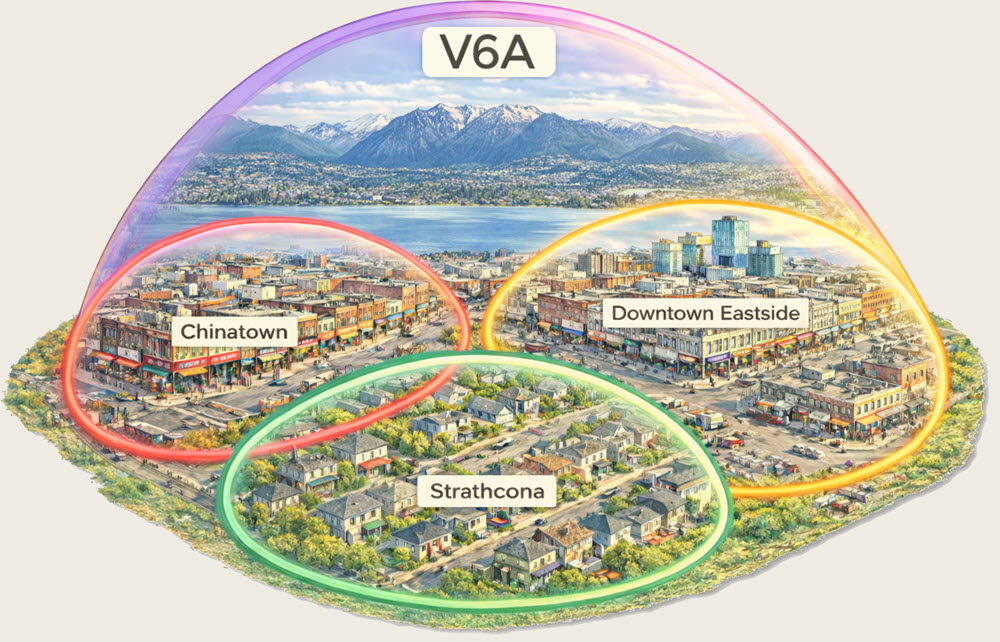
FIMBY was shaped in Vancouver’s Downtown Eastside, a neighbourhood marked by beauty, resilience, addiction, displacement, poverty, and deep community. Twenty years of neighbouring there taught one thing plainly: the people closest to you are often the ones who keep you going. An app can’t fix what ails a block, but we’ve seen what changes when people know one another by name.
Where money is tight, that kind of closeness isn’t only warm. It’s practical. A borrowed drill, a split bulk-buy, a skill shared instead of hired: small exchanges that let a household lean on its neighbours instead of going without. Sharing what’s already on the block is one of the oldest ways a neighbourhood has held itself together.
It grew out of a church community that learned faith looks like showing up for people unlike you. If those roots make you wary, it’s worth knowing the founder is gay and fully affirming. No one here is asked to hide who they are in order to belong. More on that →
Some neighbours share a prayer request because that’s part of their life; some don’t, just like every neighbourhood. Local community groups, centres, and churches have a place here too, sharing meals, events, and steady help, so informal care and formal supports sit a little closer together.
It just gives good neighbouring somewhere to grow.
Wondering where this could lead?
Read our vision.
Ring the doorbell?
If this neighbourhood is part of your real life, you’re welcome here.
Check your neighbourhood
with your postal code
activates your account
happening nearby
FIMBY not in your neighbourhood yet? Sign up anyway. We’ll add you to the waitlist and let you know when FIMBY launches near you.
Part of a community group or organization? You can join too. Just tick the box when you sign up.
For adults 19+. Families welcome: parents add a family profile from their own login. More in the FAQ.
Bring FIMBY here
FIMBY grows one neighbourhood at a time. If you’re a neighbour, organizer, church, or community group who’d help launch a hub, we’d love to hear from you.
- Gather 10–20 neighbours you can actually recognize
- Host a low-key intro: coffee, porch, or community room
- Optional moderator role with support from the FIMBY team
Still have questions?
You’ll find reassurance in our FAQ.
- Jeremy B. Merrill & Will Oremus, “Facebook prioritized ‘angry’ emoji reaction posts in news feeds,” The Washington Post (Oct 26, 2021): internal documents show reaction emoji, including “angry,” were weighted five times a “like.” washingtonpost.com
- Mike Allen, “Sean Parker: Facebook was designed to exploit human ‘vulnerability’,” Axios (Nov 9, 2017): Facebook’s founding president describes a “social-validation feedback loop” giving users “a little dopamine hit.” axios.com
- “How Meta Earns from Ads and Ventures into the Metaverse,” Investopedia: roughly 98–99% of Meta’s 2023 revenue came from advertising. investopedia.com
- “Myanmar: Facebook’s systems promoted violence against Rohingya; Meta owes reparations,” Amnesty International (Sept 29, 2022): finds Meta’s algorithms “proactively amplified” anti-Rohingya hate ahead of the 2017 atrocities. amnesty.org
- Georgia Wells, Jeff Horwitz & Deepa Seetharaman, “Facebook Knows Instagram Is Toxic for Teen Girls, Company Documents Show,” The Wall Street Journal (Sept 14, 2021): internal research the company played down in public. wsj.com
Facebook and Instagram are owned by Meta Platforms, Inc. Everything above is publicly reported by independent journalists and human-rights researchers, linked here so you can verify each claim for yourself. This isn’t about vilifying anyone. It’s just naming the choices FIMBY made differently.